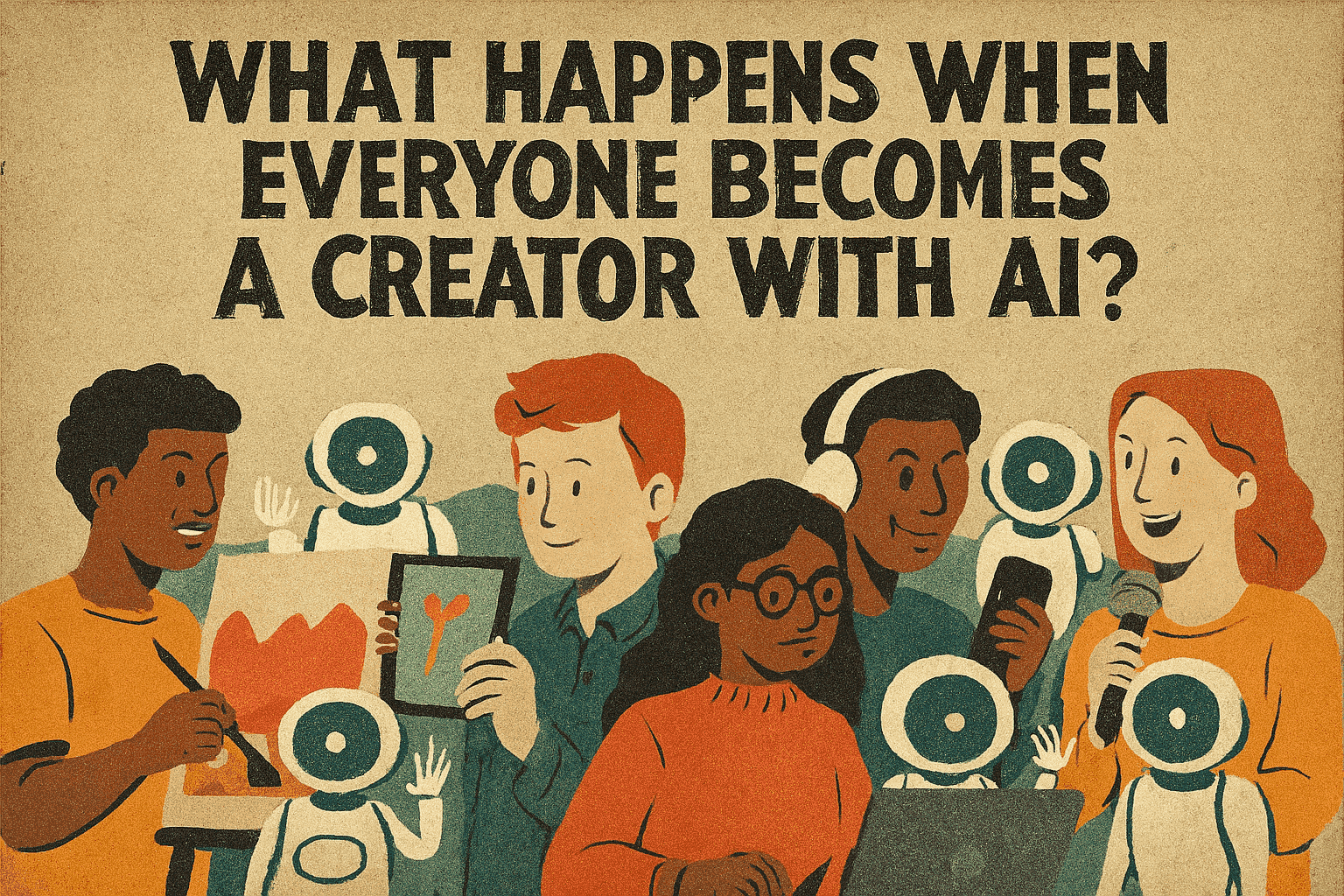
If everyone can make art, who decides what’s worth keeping?
The New Age of Effortless Creation
Not long ago, creativity was seen as a kind of magic — something you earned through years of practice, patience, and failure. Painters had to mix pigments. Writers had to wrestle with blank pages. Musicians had to understand the language of sound.
Now, with a few typed prompts, anyone can generate a painting, a song, or a screenplay in seconds. We’ve entered a new era where the barrier to entry has vanished. Creativity has been democratized — and that’s both exhilarating and unsettling.
Because when everyone can create, we have to ask: what does creation even mean anymore?
The Democratization of Creative Tools
AI has done something revolutionary — it’s made artistic expression available to everyone.
You don’t need a degree in design to generate a logo. You don’t need years of training to compose a film score. Tools like ChatGPT, Midjourney, and Suno are turning imagination into output instantly.
This is progress in the truest sense. For centuries, access to creative power was limited — by education, geography, or economics. Now, a 15-year-old with a laptop can do what once required an entire studio.
But with accessibility comes abundance. And abundance brings a new kind of scarcity — attention.
The Flood of AI-Generated Content
Scroll through any creative platform today, and you’ll see it: a deluge of beautiful, interesting, but strangely hollow creations.
Millions of poems, paintings, songs, essays — many impressive, few memorable. It’s not that AI-made art lacks skill; it’s that skill is no longer rare. When the means of creation are free, the meaning of creation shifts.
In this flood of output, the challenge isn’t making something — it’s making something that matters.
So the question becomes: how do we navigate a world where quantity is infinite and quality is subjective?
Curation as the New Creativity
In the coming decade, curation will become as valuable as creation once was.
Those who can filter, interpret, and contextualize the overwhelming flow of AI-made work will shape culture more than those who simply generate.
Think of it this way:
- Creativity 1.0 was about making things from scratch.
- Creativity 2.0 is about finding meaning in the noise.
The new artist may not always be the one who creates the image — but the one who knows which image to keep, how to frame it, and what story to tell with it.
Taste, intuition, and emotional depth — these are the new frontiers of artistry in the age of automation.
The Future of Taste and Meaning
When everyone becomes a creator, the role of the audience changes too. We’re no longer passive consumers; we’re all part of the cultural algorithm — liking, sharing, remixing, and training the next generation of AI models.
The future of creativity won’t be defined by output volume, but by depth of connection.
The art that will endure won’t necessarily be the most polished — it will be the most human.
The ones that make us pause, reflect, or feel seen will stand out amid the endless scroll.
AI can mimic beauty, but it can’t manufacture meaning. That still belongs to us.
A Closing Thought
The question isn’t whether AI will replace artists. It’s whether we, as humans, will remember why we make art in the first place.
In this new creative renaissance, our challenge isn’t to compete with machines — it’s to create with intention.
Because in a world where everyone can make something, what truly matters is the courage to make something worth keeping.