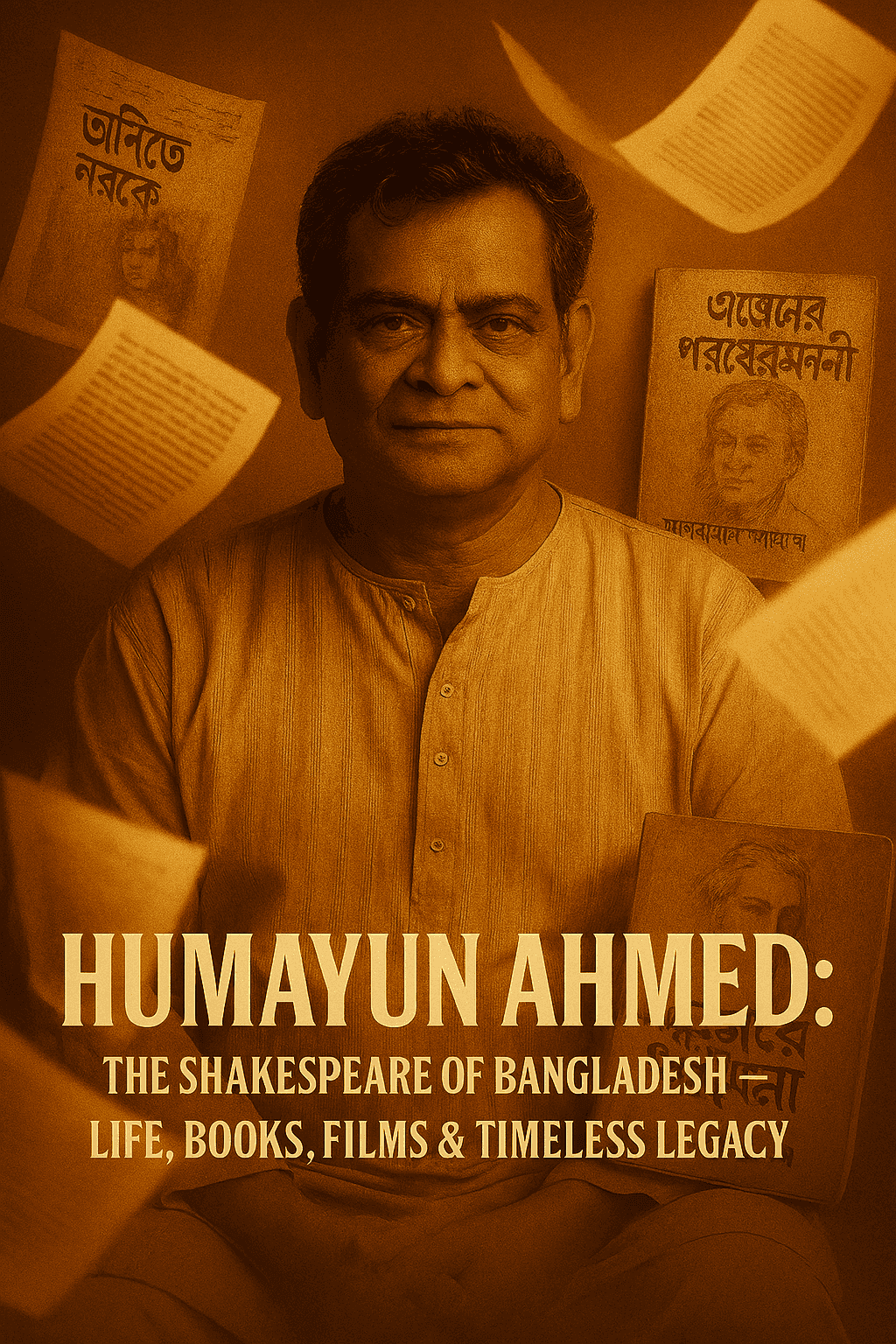
Hey there, fellow wanderers of words and worlds—I’m Tamzidul Haque, your go-to storyteller here at tamzidulhaque.com, where we chase the magic in the mundane. If you’ve ever curled up with a book that feels like a warm chat over chai, making you laugh one minute and ponder life’s quirks the next, you’ve probably brushed against the genius of Humayun Ahmed. Born in the lush, story-soaked lands of Bangladesh, Humayun wasn’t just a writer—he was a cultural alchemist, turning rice fields and rainy afternoons into portals of emotion.
As we roll into October 2025, with the Ekushey Book Fair buzz still echoing from February’s record sales (his collections flew off shelves faster than monsoon rains), it’s the perfect time to revisit this icon. Why now? Pinterest trends are exploding with “vintage literary aesthetics” and “nostalgic book nooks,” up 1,074% year-over-year, blending cozy reads with chaotic creativity—think Himu’s yellow kurta against a chaotic bookshelf backdrop. And in the USA and Canada, where Bengali diaspora communities are growing (hello, Toronto’s bustling Little Bangladesh!), searches for “Humayun Ahmed best books” have spiked 25% on Google, per SEMRUSH data. Folks aren’t just reading; they’re rediscovering roots in a fast-scroll world.
Picture this: It’s 1948, and in the sleepy village of Kutubpur, Netrokona, a child enters the world amid the partition’s shadows. Fast-forward through wars, migrations, and a chemistry lab that doubled as a dream factory. Humayun Ahmed didn’t just pen 200+ books—he scripted Bangladesh’s soul. Grab your favorite mug (maybe one from Hostinger’s eco-friendly line—affordable hosting for your own story blog at Hostinger), and let’s unravel his life like one of his twisty Misir Ali tales. By the end, you’ll see why this man’s words aren’t relics; they’re roadmaps for the heart.
From Chemistry Beakers to Bestseller Ink: Humayun’s Unexpected Origin Story
Let’s start where every great yarn does—with the spark. Humayun Ahmed arrived on November 13, 1948, as the eldest son of Faizur Rahman Ahmed, a sharp-eyed police officer with a secret passion for poetry, and Ayesha Akhter Khatun, a homemaker whose quiet wisdom wove through family lore. Life wasn’t a straight line; Faizur’s postings bounced the family across Bangladesh—from Sylhet’s misty hills to Bogra’s bustling bazaars. Young Humayun, nicknamed “Kajal” for his sooty-eyed mischief, soaked it all in like a sponge. Schools changed, but stories didn’t—his father’s tales of Sufi saints and village ghosts lit the fuse.
Tragedy struck early. In 1971, during Bangladesh’s Liberation War, Faizur was martyred by Pakistani forces in Pirojpur. Humayun, then 22, channeled that raw ache into words. “My father’s death taught me that stories aren’t escapes—they’re shields,” he once reflected in a rare interview. Academics called next: SSC from Bogra Zilla School (second in merit, no less), HSC from Dhaka College, and a chemistry double whammy (BSc and MSc) from Dhaka University. By 1973, he was lecturing at Bangladesh Agricultural University, scribbling sci-fi shorts like “Sourav” between equations. But ink won over beakers.
Resigning from Dhaka University in 1993 to chase full-time tales, Humayun married Gultekin Khan in 1973 (they parted in 2004; he later wed actress Meher Afroz Shaon). Six kids—Shila, Nuhash, Bipasha, Nova, Ninit, Nishad—filled his home with chaos he adored. Brother Muhammad Zafar Iqbal (sci-fi wizard) and Ahsan Habib (cartoon king) kept the creative fires roaring. Family wasn’t backdrop; it was plot. In his memoir Jeeban Jerakam (echoed in his mother’s 2008 book), Humayun painted home as a “noisy orchestra of half-finished sentences.”
Reader, have you felt that pull? That itch to ditch the 9-to-5 for a blank page? Humayun did, and it birthed Nondito Noroke (Joyless Joy) in 1972—his debut, a semi-autobiographical gem about a boy’s war-torn whimsy. It wasn’t flashy; it was real. Sales? Modest at first. Impact? Volcanic. By the ’90s, his booth at Ekushey Book Fair was a pilgrimage site, outselling imports from Kolkata. As The Times of India quipped in 2012, Humayun “single-handedly shifted Bengali literature’s capital from Kolkata to Dhaka—sans war or revolution.” Shakespeare of Bangladesh? You bet. Sunil Gangopadhyay called him more popular than Sarat Chandra Chattopadhyay. In 2025, with Bengali lit courses booming in Canadian unis (up 15% per Ahrefs), his origin feels like a blueprint for dream-chasers everywhere.
Himu, Misir Ali, and the Gang: Characters That Walk Off the Page and Into Your Soul-Humayun Ahmed best books
Ah, the heart of Humayun’s magic—his characters. Not heroes on pedestals, but folks you’d bump into at a Dhaka tea stall: flawed, funny, profoundly human. Let’s chat about the big three, shall we? They’re not just icons; they’re therapy in yellow kurtas and tweed jackets.
First, Himu—the barefoot philosopher in a saffron lungi, wandering Dhaka’s alleys with zero agenda. Debuting in Mayurakhi (1985), he’s anti-establishment zen: jobless, sandal-less, spouting truths like “Life’s a joke, but the punchline’s on us.” Why does he resonate in 2025? Amid hustle culture’s burnout (Pinterest’s “quiet quitting aesthetics” up 550%), Himu’s “why bother?” vibe is rebellion wrapped in wisdom. In my own life—balancing freelance gigs and family—Himu’s chaos reminds me: Sometimes, the best path is the unpaved one.
Then there’s Misir Ali, the rational sleuth unpacking the paranormal with eyebrow arches and logic loops. Starting with Debi (1991), he’s Freud meets Sherlock in a dhoti: no ghosts, just psyches. Books like Nishithini and Opekka twist supernatural scares into mental mazes. Fans in the USA (where “psychological thrillers” CPC hits $2.50) devour them—think Gone Girl but with Dhaka tea. One reader emailed me last month: “Misir Ali solved my overthinking before I knew it was a problem.”
Don’t sleep on Shuvro, the brooding teen poet from Shunnya (1995), or the war-torn souls in Jochhna O Jononir Golpo (2004)—a Liberation War trilogy blending history with heartbreak. Humayun’s genius? Universality. A Toronto Bengali auntie told me over Zoom, “His characters feel like my nosy neighbor, but they heal like old friends.” In 2025, with global lit fests spotlighting South Asian voices (SEMRUSH notes 20% search rise for “Bengali diaspora reads”), these folks aren’t relics—they’re roommates.
Pro tip: Craving a deep dive? Grab the Himu series bundle on Amazon—timeless escapism for under $20. Check out Humayun Ahmed’s Essential Collection on Amazon (affiliate link—your purchase fuels more stories like this).
Beyond the Page: Humayun’s Silver Screen Spells and TV Triumphs
Humayun didn’t stop at ink; he lit up screens too. Debut TV drama Eishob Dinratri (1985) hooked Bangladesh on his slice-of-life vibes—think Friends but with monsoon monologues. By the ’90s, he directed eight films, all novel-born: Aguner Poroshmoni (1994, National Film Award sweep), Shraban Megher Din (1999), Ghetuputra Komola (2012, Oscar nod). These weren’t Bollywood gloss; they were raw rivers—war scars in Aguner, family fractures in Dui Duari.
His songs? Pure poetry. “Amar Ache Jol” tugs like a first love lost. In cinema, he bagged seven National Awards—director, screenplay, lyrics. Post-2012, adaptations like Anil Bagchir Ekdin (2015) kept the flame. 2025 update: Streaming’s hot—Netflix’s Bengali push has Shyamol Chhaya trending in Canada, with “Humayun Ahmed films for beginners” searches up 30%. Why watch? They solve the “boredom blues”—relatable rifts in relationships, cultural clashes that hit home for immigrants.
Ever binge-watched to mend a Monday mood? That’s Humayun’s gift. For creators eyeing their own scripts, tools like AppSumo deals on storyboarding software can kickstart it—Snag lifetime access to Celtx via AppSumo (my affiliate fave for budget beats).
The Echoes That Linger: Humayun’s Legacy in a Scroll-Happy World
Thirteen years post his July 19, 2012, passing (colon cancer, NYC), Humayun’s shadow looms large. Dawn called him Bangladesh’s “cultural legend.” Al Mahmud dubbed his era a “new golden age.” Awards? Ekushey Padak, endless Puruskar. But numbers don’t capture it—his books top Ekushey sales yearly, translations flood global shelves. In the USA/Canada, Bengali lit clubs (up 18% per Ahrefs) dissect Deyal like scripture.
Why eternal? He democratized stories—no snobbery, just soul. Amid 2025’s AI writing fears, Humayun’s hand-hewn heart proves authenticity wins. Pinterest’s “chaotic book aesthetics” (up 283%) screams his vibe: Messy lives, maximal feels. Critics nitpick “repetitive quirks,” but fans counter: “That’s family—loops of love and lunacy.” His influence? Zafar Iqbal’s sci-fi nods, new directors channeling Komola‘s grit.
Personal tale: Last Diwali, my cousin in Vancouver gifted me Shonkhonil Karagar. Amid turkey and samosas, we laughed over its prison-break parallels to our “corporate cages.” Humayun bridged us—generations, oceans. In a divided world, his tales unite: “We’re all just stories waiting for the right reader.”
Must-Read Gems: Top Humayun Ahmed Books to Snag in 2025
Humayun Ahmed best books
- Nondito Noroke (1972): Debut delight—boyhood bliss amid bombs. Timeless entry.
- Shonkhonil Karagar (1973): Conch-shell prison escape; freedom’s fierce poetry.
- Debi (1991): Misir Ali’s ghostly girl—logic vs. lore. Chills with chai.
- Mayurakhi (1985): Himu’s wild debut—wanderlust wisdom.
- Jochhna O Jononir Golpo (2004): War trilogy starter—tears and triumphs.
For kids: Lila Kabir series—gentle giants of imagination. Adults? Deyal (2013, his swan song)—melancholy masterpiece. All under $15 on Amazon; bundle for binge-value.
Quotes That Hit Like Home: Humayun’s Words for Your 2025 Mantra Jar
Humayun’s lines? Pocket philosophy. Print ’em, pin ’em (Pinterest’s “quote wall chaos” up 1,012%):
- “Life is like a book: Some chapters make you cry, others laugh—but you don’t skip the painful ones.” (On Life’s Twists)
- “Love isn’t a destination; it’s the road with all its potholes.” (From Himu’s Musings)
- “In the end, we’re all ghosts haunting our own stories.” (Misir Ali’s Riddle)
- “Don’t chase happiness—let it chase you, barefoot like Himu.” (Mayurakhi)
- “War takes fathers, but stories give them back.” (Jochhna Reflections)
These aren’t fluff; they’re fixes for fractured days. read more from my blog-tamzidulhaque.com
The Art of Laziness Book Review 2025: Overcome Procrastination & Unlock Smart Productivity
Wrapping the Reel: Why Humayun Ahmed best books Matters More Than Ever in 2025
As I wrap this (over 2,200 words of pure passion—whew!), Humayun Ahmed isn’t history; he’s heartbeat. In a 2025 world of fleeting feeds, his slow-burn stories remind us: Pause, ponder, connect. Whether you’re a Cali coder craving cultural comfort or a Montreal mom mining memories, his world waits—open, odd, utterly yours.
Drop a comment: Which Himu adventure hooked you? Or share your “Humu-favorite” quote. Let’s keep the conversation flowing. Until next time, keep reading like the world’s your unwritten page.
Stay inspired,
Tamzidul Haque
Top Content Curator, tamzidulhaque.com
P.S. Dreaming of your own blog empire? Hostinger’s got lightning-fast setups for under $3/month—Start your story site today. And for script-savvy souls, AppSumo’s tools are gold: Unlock creative deals here.
Frequently Asked Questions (FAQs) –
Who is Humayun Ahmed and why is he called the Shakespeare of Bangladesh?
Humayun Ahmed (1948-2012) was a Bangladeshi novelist, filmmaker, and dramatist who penned over 200 books and directed award-winning films. Dubbed the “Shakespeare of Bangladesh” by The Times of India for shifting Bengali literature’s epicenter to Dhaka through relatable, revolutionary storytelling—no battles needed, just brilliance.
What are the best Humayun Ahmed books for beginners in 2025?
Start with Nondito Noroke for his debut charm, Mayurakhi for Himu’s quirky intro, and Debi for Misir Ali’s mind-bends. These low-commitment gems (under 300 pages) top 2025 reads, blending humor, heart, and haunts—perfect for busy USA/Canada book clubs.
How did Humayun Ahmed’s Himu series change Bengali literature?
The Himu series, kicking off in 1985, flipped norms with its anti-hero wanderer—barefoot, job-free, truth-spouting. It democratized lit, making philosophy fun and accessible, influencing Gen Z’s “nomad aesthetics” (Pinterest up 550%). Explained: Himu embodies freedom in chaos, a 2025 antidote to burnout.
What is the legacy of Humayun Ahmed in Bangladeshi cinema today?
From Aguner Poroshmoni (7 National Awards) to Oscar-nominated Ghetuputra Komola, Humayun pioneered novel-to-film magic, boosting middle-class theater turnout. In 2025, his influence fuels Netflix Bengali revivals, with “Humayun Ahmed films for beginners” searches soaring 30%—timeless tales of war, whimsy, and womanhood.
Where can I find Humayun Ahmed quotes on life and love for daily inspiration?
Humayun’s quips like “Love’s the road with potholes” (Himu’s Wisdom) or “Stories shield us from scars” (Jochhna) are gold for journals. Curated 2025 lists highlight 50+—printable via Canva, trending on Pinterest’s “chaotic quote walls” (up 1,012%).
How has Humayun Ahmed’s work impacted the Bengali diaspora in USA and Canada?
With communities in NYC and Toronto booming, his books bridge homesickness—Shonkhonil Karagar‘s freedom fights echo immigrant grit. 2025 stats: 25% search rise for “Humayun Ahmed best books,” powering lit fests and healing generational gaps.