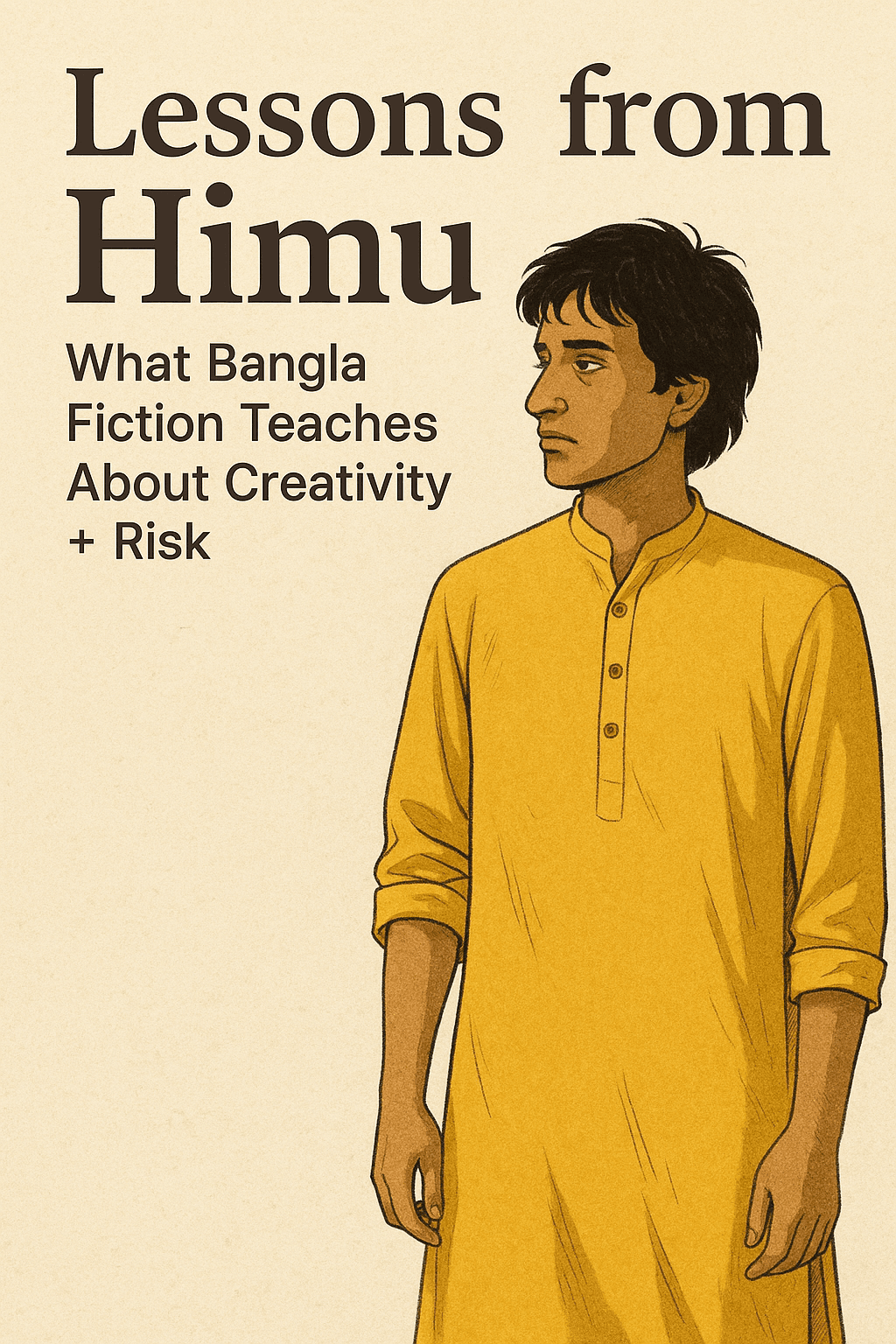
Lessons from Himu If you’ve ever wandered through the streets of Dhaka—or even just wandered through the pages of Bangla fiction—you’ve probably met Himu.
He’s the barefoot, yellow panjabi‑wearing wanderer created by legendary writer Humayun Ahmed.
Himu doesn’t hold a job. He doesn’t chase wealth. He doesn’t even believe in the conventional idea of success. Instead, he walks. He observes. He lives by instinct and randomness.
To most, he’s a madman. To a few, he’s a sage.
But here’s the kicker: Himu is also a radical case study in creativity and risk‑taking. And in an age where we’re all obsessing over productivity hacks, startup blueprints, and “safe” career choices—maybe Himu has something to teach us.
🎨 Lessons from Himu 1: Creativity Thrives in Chaos
Himu doesn’t plan his days. He doesn’t carry notebooks or five‑year strategies. He simply goes where his feet take him.
That sounds reckless. But it’s also how many creative breakthroughs happen—artists stumbling into new styles, entrepreneurs pivoting into billion‑dollar ideas, writers discovering fresh plots by accident.
👉 Takeaway: Stop overengineering every creative act. Allow space for randomness, detours, and chaos—you’ll be surprised where it leads.
⚡ Lessons from Himu 2: Risk is a Muscle, Not a Gamble
Most of us avoid risk because we’re trained to fear loss. But Himu? He’s all about living on the edge. No job, no savings, no plan B—just faith that life sorts itself out.
I’m not saying quit your job and start walking barefoot. But Himu reminds us that risk isn’t a one‑time leap—it’s a habit. Every small risk you take strengthens your creative and entrepreneurial tolerance.
👉 Takeaway: Start with micro‑risks. Each one expands your capacity for bold moves.
🧠 Lessons from Himu 3: Question the Script You’ve Been Handed
Himu constantly pushes back against the “normal” expectations of life—job, marriage, money, respectability. He rewrites the script.
That’s exactly what creative thinkers do. From Steve Jobs to Rabindranath Tagore, every innovator asked: Why do we have to do it this way?
👉 Takeaway: Every time you feel trapped by “the right way,” pause and ask: Says who?
🌍 Lessons from Himu 4: Creativity Without Fear of Judgment
One of Himu’s most striking traits is how little he cares about what others think. Walk barefoot on the street? Fine. Speak uncomfortable truths? Absolutely.
Creativity dies when we obsess over validation. True innovation requires stepping into the world as if you owe no one an explanation.
👉 Takeaway: Build your craft for its own sake first—recognition comes later.
Read more these type of content from my medium blogs
🚶 Lessons from Himu 5: Simplicity Fuels Depth
Himu owns nothing but a yellow panjabi. Yet his thoughts go deeper than most. He shows us that simplicity—of possessions, of distractions, of goals—creates space for richer ideas.
👉 Takeaway: Simplify your environment, declutter your goals. Creativity thrives in focus, not in overwhelm.
✨ Why Himu Still Matters in 2025
Himu is fictional, but his lessons are real. In a world hooked on certainty, he’s a reminder that creativity lives in uncertainty, and risk‑taking is the ultimate art form.
We don’t need to copy Himu’s lifestyle. But maybe we need a little of his spirit. A little barefoot wandering. A little madness. A little courage to risk looking foolish while chasing something original.
⚡ TL;DR (Short Summary)
Himu, the iconic wanderer of Bangla fiction, shows us that:
- Creativity grows in chaos.
- Risk is a muscle, not a gamble.
- Questioning norms sparks innovation.
- Judgment kills originality.
- Simplicity creates focus.
👉 In short: To create and to risk is to live fully.
📚 Want to Explore Himu?
Affiliate disclosure: This link helps support more literary deep dives like this at no extra cost to you.
👉 Read the Himu Series by Humayun Ahmed on Amazon