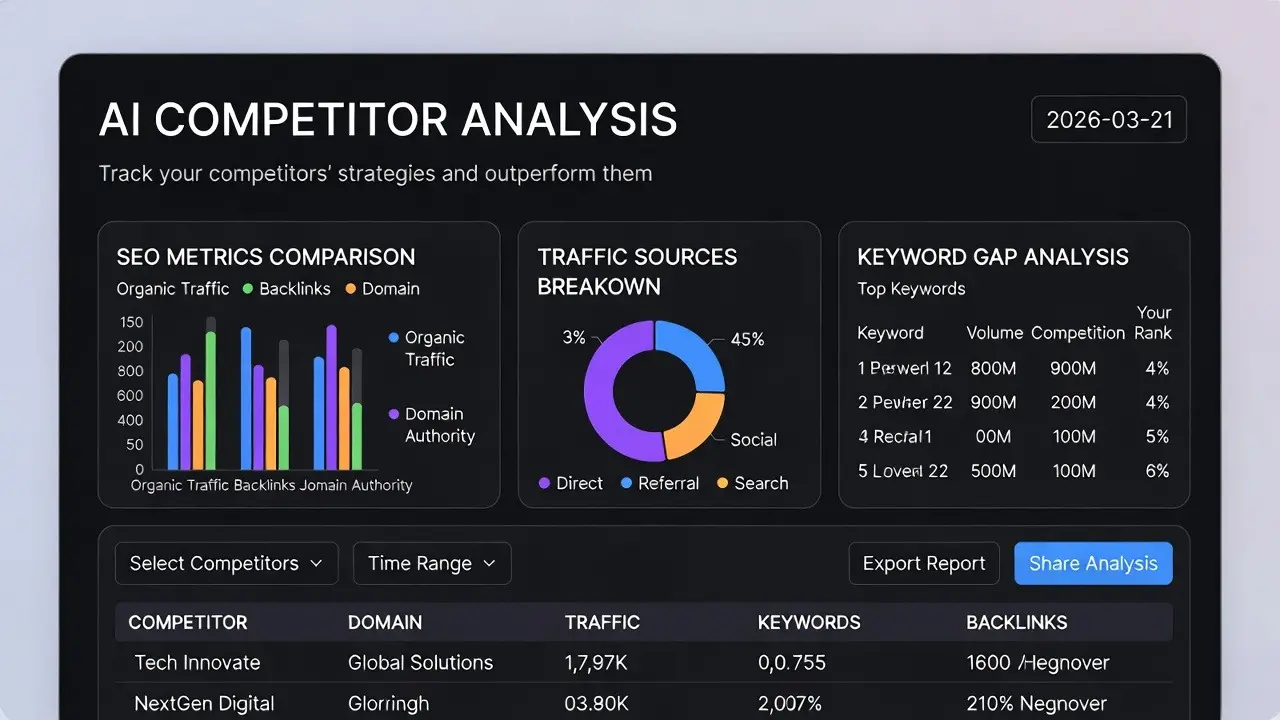
The best AI tools for competitor analysis in 2026 empower businesses, marketers, bloggers, and content creators to uncover hidden opportunities, spot weaknesses in rivals’ strategies, and make data-driven decisions that drive growth.
Whether you’re optimizing for SEO, tracking content performance, monitoring website changes, analyzing traffic sources, or benchmarking social presence, AI tools for competitor analysis automate what used to take hours of manual research.
In today’s hyper-competitive digital landscape—especially with AI search engines like Google AI Overviews reshaping visibility—the right competitor analysis tools help you outrank, out-engage, and outperform others while saving time and budget.
This in-depth guide covers the top AI-powered competitor analysis tools, their core features, real-world use cases, pricing insights, and step-by-step guidance on how to use them effectively. By the end, you’ll know exactly which tools fit your needs and how to integrate them into your workflow for maximum impact.
Why Competitor Analysis Matters More Than Ever in 2026
Competitor analysis isn’t just about “spying”—it’s strategic intelligence.
- Identify content gaps your site can fill to capture more traffic.
- Discover keywords competitors rank for that you overlook.
- Track website changes, pricing shifts, or new features before they impact your market share.
- Benchmark traffic sources, engagement metrics, and backlink strategies.
- Adapt to AI-driven search where visibility in generative answers (like ChatGPT or Gemini summaries) becomes a key ranking factor.
Without tools, you’re guessing. With AI-enhanced platforms, you get automated insights, predictive trends, and actionable recommendations.
Common objection: “These tools are expensive.” Many offer free tiers or trials, and the ROI from even one good keyword win or traffic insight often pays for the subscription multiple times over.
Core Types of AI Competitor Analysis Tools (best competitor analysis tools 2026)
Modern tools fall into these categories:
- SEO & Keyword-Focused — Deep dives into organic search performance.
- Traffic & Market Intelligence — Estimates visitors, sources, and audience overlap.
- Website & Change Monitoring — Real-time alerts on updates.
- Content & Social Listening — Analyzes top-performing content and mentions.
- All-in-One Competitive Intelligence — Automates reports, battlecards, and monitoring.
Now, let’s explore the standout options- AI tools for competitor analysis
1. Semrush – The All-in-One Powerhouse for SEO & Competitive Research
Semrush remains a leader in 2026 thanks to its massive database and AI integrations like Semrush Copilot and AI Visibility Toolkit.
Key AI-Powered Features for Competitor Analysis
- Organic Research → See competitors’ top keywords, positions, traffic estimates, and content gaps.
- Keyword Gap → Find keywords competitors rank for that you don’t.
- Backlink Analytics → Compare link profiles and discover outreach opportunities.
- Market Explorer → Benchmark traffic share, audience overlap, and market trends.
- AI Visibility Toolkit → Track how often your brand (vs. competitors) appears in AI-generated search answers.
- Copilot → AI assistant delivers personalized recommendations based on competitor data.
Best For — Bloggers, SEO agencies, e-commerce sites, and content marketers focused on organic growth.
Pricing — Starts around $139.95/month (Pro); higher tiers unlock more data limits and AI features.
Pro Tip — Start with the free account to run basic competitor reports, then upgrade when you need daily tracking.
2. Ahrefs – King of Backlinks & Keyword Intelligence
Ahrefs excels at revealing what drives competitors’ SEO success.
Standout Features
- Site Explorer → Enter a competitor URL and get instant keyword rankings, traffic value, and top pages.
- Content Gap → Massive keyword database shows untapped opportunities.
- Backlink Checker → Analyze strongest links and anchor texts competitors use.
- Rank Tracker → Monitor position changes over time (including vs. rivals).
Best For — SEO professionals and publishers who prioritize backlinks and long-term organic authority.
Pricing — From ~$129/month.
Real-World Example — If a competitor ranks #1 for “best AI writing tools,” Ahrefs shows you the exact pages, backlinks, and traffic volume—then helps you build a better version.
3. Similarweb – Best for Traffic & Market Share Insights
Similarweb uses AI to estimate real traffic data when direct analytics aren’t available.
Key Capabilities
- Traffic estimates by channel (organic, paid, direct, referral, social).
- Audience demographics and interests.
- Competitor benchmarking and market intelligence reports.
- App intelligence for mobile competitors.
Best For — Businesses needing big-picture market share data or e-commerce players analyzing industry benchmarks.
Pricing — Starts around $125/month for basic plans.
4. Visualping – AI-Powered Website Change Detection
Visualping monitors any website section and alerts you to changes—perfect for tracking competitor updates without constant manual checks.
Features
- AI detects meaningful changes (pricing, new features, copy tweaks).
- Visual comparisons and historical archives.
- Integrations with Slack, email, etc.
Best For — Monitoring landing pages, pricing, or blog updates from direct competitors.
Pricing — Free tier available; paid plans for frequent monitoring.
5. Other Strong Contenders Worth Considering
- SpyFu — Affordable PPC and keyword spying (great if competitors run heavy ads).
- Panoramata — Tracks emails, ads, landing pages—strong for e-commerce and DTC brands.
- Crayon — Enterprise-level competitive intelligence with real-time monitoring.
- Competely.ai — Instant AI-generated competitive reports on features, pricing, messaging.
- Brand24 or Sprout Social — Social listening to track mentions and sentiment.
For pure content creators: Tools like Surfer SEO or ContentShake AI (powered by Semrush data) help analyze top-ranking competitor content and optimize yours accordingly.
How to Build Your Competitor Analysis Workflow in 2026 (Step-by-Step)
- Identify 5–10 Direct Competitors — Use Similarweb or Semrush Market Explorer.
- Set Up Core Tracking — Add sites to Visualping for change alerts; input domains in Semrush/Ahrefs for ongoing data.
- Run Gap Analyses Weekly — Check keyword gaps and content opportunities.
- Monitor AI Visibility — Use Semrush AI tools to see who’s winning in generative search.
- Automate Alerts — Connect tools to Slack/email for real-time updates.
- Review & Act Monthly — Turn insights into content calendars, link-building targets, or feature ideas.
This workflow takes ~2–4 hours/month once set up but delivers ongoing wins.
Common Questions & Objections Addressed
- “Are free alternatives good enough?” — ChatGPT, Gemini, or Perplexity can handle basic competitor summaries, but they lack real-time data, historical trends, and accuracy of dedicated tools.
- “Which one should I start with on a budget?” — Begin with Semrush or Ahrefs free trials + Visualping free plan.
- “Do these tools work for non-SEO niches?” — Yes—traffic tools like Similarweb and monitoring like Crayon apply broadly.
Conclusion & Next Steps– Competitor analysis tools
The best AI tools for competitor analysis in 2026 combine massive data with smart automation to give you an unfair advantage. Start with Semrush or Ahrefs for SEO depth, add Visualping for monitoring, and layer in traffic insights from Similarweb.
Pick one tool today, run your first competitor report, and watch opportunities appear. Consistent analysis turns “who are my competitors?” into “how do I beat them?”
How to Connect Custom Domain to GitHub Pages in 2026 (Free & Easy Step-by-Step)
How to Make Your AI Content Sound Like a Human (Step-by-Step Guide for 2026)
FAQ
What is the best AI tool for competitor analysis in 2026?
Semrush stands out as the most comprehensive, with strong AI features like Copilot and AI Visibility Toolkit for SEO, content, and AI search tracking.
Are there free AI tools for competitor analysis?
Yes—limited free tiers in Semrush, Ahrefs, Similarweb, and Visualping. General AIs like ChatGPT can provide basic insights but lack proprietary data.
How do I do competitor analysis for SEO?
Use Semrush or Ahrefs to check keyword gaps, top pages, backlinks, and content performance. Focus on high-volume, low-difficulty opportunities.
What tool tracks competitor website changes automatically?
Visualping uses AI to monitor and alert on visual or content changes.
Which tool is best for traffic comparison?
Similarweb provides the most accurate third-party traffic estimates and channel breakdowns.
Can AI tools help with PPC competitor analysis?
Yes—SpyFu specializes in PPC keywords and ad history; Semrush also covers paid search.
How much do competitor analysis tools cost?
Entry-level plans start at $100–150/month (Semrush, Ahrefs, Similarweb); free trials are common.
Is competitor analysis worth it for small blogs?
Absolutely—uncovering content gaps and better keywords can 2x–5x organic traffic with minimal extra work.