Imagine this. Back in 2015, I chatted with a buddy who dumped his savings into “hot” active mutual funds. He chased managers who promised to beat the market. Fast forward to 2026—he’s frustrated. His returns? Mediocre at best. Meanwhile, my boring S&P 500 index fund? It’s grown steadily, with almost zero effort.
Sound familiar? You’re not alone. Millions in the USA and Canada wonder the same thing: Should I go active or passive?active vs index funds
In simple terms:
- Active funds — Managers pick stocks to beat the market. Higher fees, more trading.
- Index funds — Track the market (like S&P 500). Low fees, passive.
The big question? Which one puts more money in your pocket long-term? active vs index funds
Let’s look at fresh data from 2025-2026.
Why Index Funds Keep Winning: The Latest 2026 Numbers
Recent reports tell a clear story.
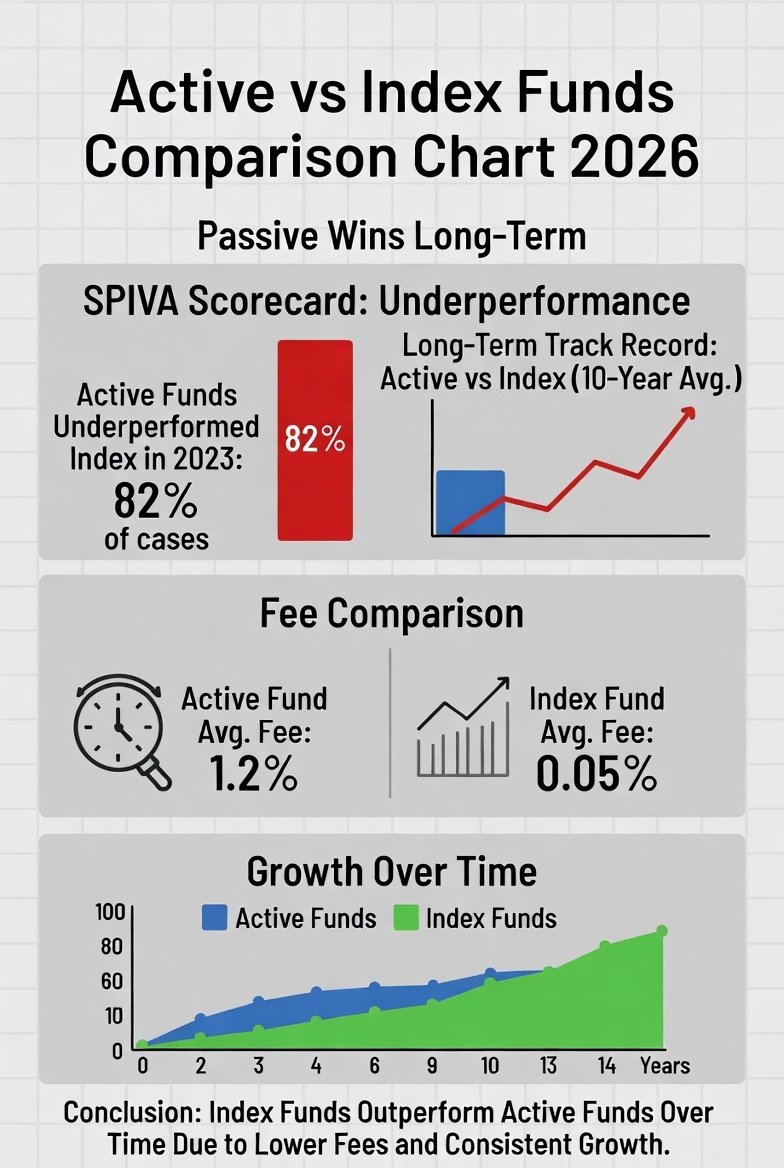
The SPIVA scorecard (mid-2025 and updates into 2026) shows most active funds underperform. Over 10 years, about 85-90% of US large-cap active funds lag the S&P 500. For all domestic equity, it’s around 90% underperformance.
Morningstar’s 2025 review? Only 21% of active strategies survived and beat passive over 10 years. That’s tough odds.
In 2025, active funds saw outflows while index funds pulled in billions. November 2025 alone: Index funds gained $94+ billion net inflows. Active? Outflows.
Why? Fees kill returns.
Active equity funds average 0.64% expense ratio. Index? Often 0.05% or less. That gap compounds huge over decades.
Example: Invest $10,000 at 7% return.
- Active (0.64% fee): ~$38,000 after 30 years.
- Index (0.05% fee): ~$76,000.
Double the money just from lower costs!
In Canada, similar trends. Passive ETFs dominate growth.
The Real Costs of Active Funds You Don’t See
Active sounds exciting. “Beat the market!” But hidden costs add up.
- Higher fees eat returns.
- More trading = more taxes in taxable accounts.
- Manager risk — even top performers fade. No consistency.
SPIVA data shows: Over 15 years, indexes beat 80-90%+ of active funds in most categories.
Even in “good” years for active (like some 2025 pockets in small-caps), long-term wins go to passive.
Story time: Warren Buffett bet $1 million that an S&P 500 index would beat hedge funds (active pros) over 10 years. He won. Big time.
When Active Funds Might Make Sense (Yes, Sometimes!)
Index funds win most times. But not always.
Active shines in:
- Less efficient markets (small-caps, emerging markets, some bonds).
- Real estate or niche areas.
- Volatile times where stock-picking avoids losers.
T. Rowe Price and others say higher rates and volatility in 2026 could help skilled active managers.
Active ETFs grow fast too—blending active picks with ETF perks.
But for most? Stick to broad US/Canada indexes.
Best Index Funds to Buy Right Now (2026 Picks)
Ready to start? Here are top low-cost index funds/ETFs for USA/Canada investors.
- Vanguard S&P 500 ETF (VOO) — Tracks S&P 500. Expense: 0.03%. Classic choice.
- Vanguard Total Stock Market ETF (VTI) — Whole US market. Super diversified.
- Schwab US Broad Market ETF (SCHB) — Similar, ultra-low cost.
- iShares Core S&P 500 ETF (IVV) — Another solid S&P tracker.
- For Canada: Vanguard FTSE Canada All Cap ETF (VCN) or iShares Core MSCI Canada (XIC).
These are boring. But boring wins.
Pro tip: If you’re in Canada, use RRSP/TFSA for tax perks. USA? Roth IRA or 401(k).
Want to host your investing journey on a fast site? I use Hostinger for my blogs—cheap, reliable hosting with great speed for WordPress. Check it out here: https://hostinger.com?REFERRALCODE=TAMZID99. (Perfect for your finance site!)
How to Get Started with Index Funds Today
Simple steps:
- Open a brokerage (Vanguard, Fidelity, Schwab—free trades).
- Pick a broad index ETF.
- Invest regularly (dollar-cost average).
- Hold long-term. Ignore noise.
Rebalance once a year. That’s it.
No need to watch daily. Passive = peace.
Common Mistakes People Make
- Chasing last year’s hot active fund (they often cool off).
- Paying high advisor fees on top.
- Panic selling in dips (index recovers best).
- Ignoring fees (they compound against you).
Avoid these. Stay simple.
Passive Investing Isn’t Boring—It’s Smart
Passive index funds let you own the economy. No guessing winners.
In 2026, with AI, tariffs, rates shifting—passive still offers the edge for most.
Active? Fun if you’re pro. For us regular folks? Index wins.
What do you think? Active or index for your portfolio?
Drop a comment below! GLP-1 Insurance Coverage 2025: The Real Story Behind Getting Wegovy, Zepbound, or Ozempic Covered for Weight Loss
FAQs
What is the difference between active vs index funds?
Active funds have managers picking stocks to beat the market. Index funds track an index like S&P 500 passively.
Are index funds better than active funds in 2026?
Yes, for most investors. Latest data shows 85-90% of active funds underperform over 10+ years due to fees.
Do active funds ever beat index funds?
Yes, some do short-term or in niches. But consistent long-term winners are rare.
What are the best index funds for beginners in USA?
VOO, VTI, IVV—low fees, broad exposure.
How much do active funds cost vs index?
Active: 0.5-1%+. Index: 0.03-0.2%. Big difference over time.
Is passive investing safe for retirement?
Yes—diversified, low-cost, historically strong returns.
Should Canadians choose index funds?
Absolutely. VCN or similar for home bias, plus global.
Why do most active managers lose to index?
Fees, trading costs, hard to beat efficient markets consistently.
Can I mix active and index funds?
Sure—core passive, satellite active for fun or niches.
Where to buy index funds in 2026?
Vanguard, Fidelity, Schwab, or Canadian brokers like Questrade.