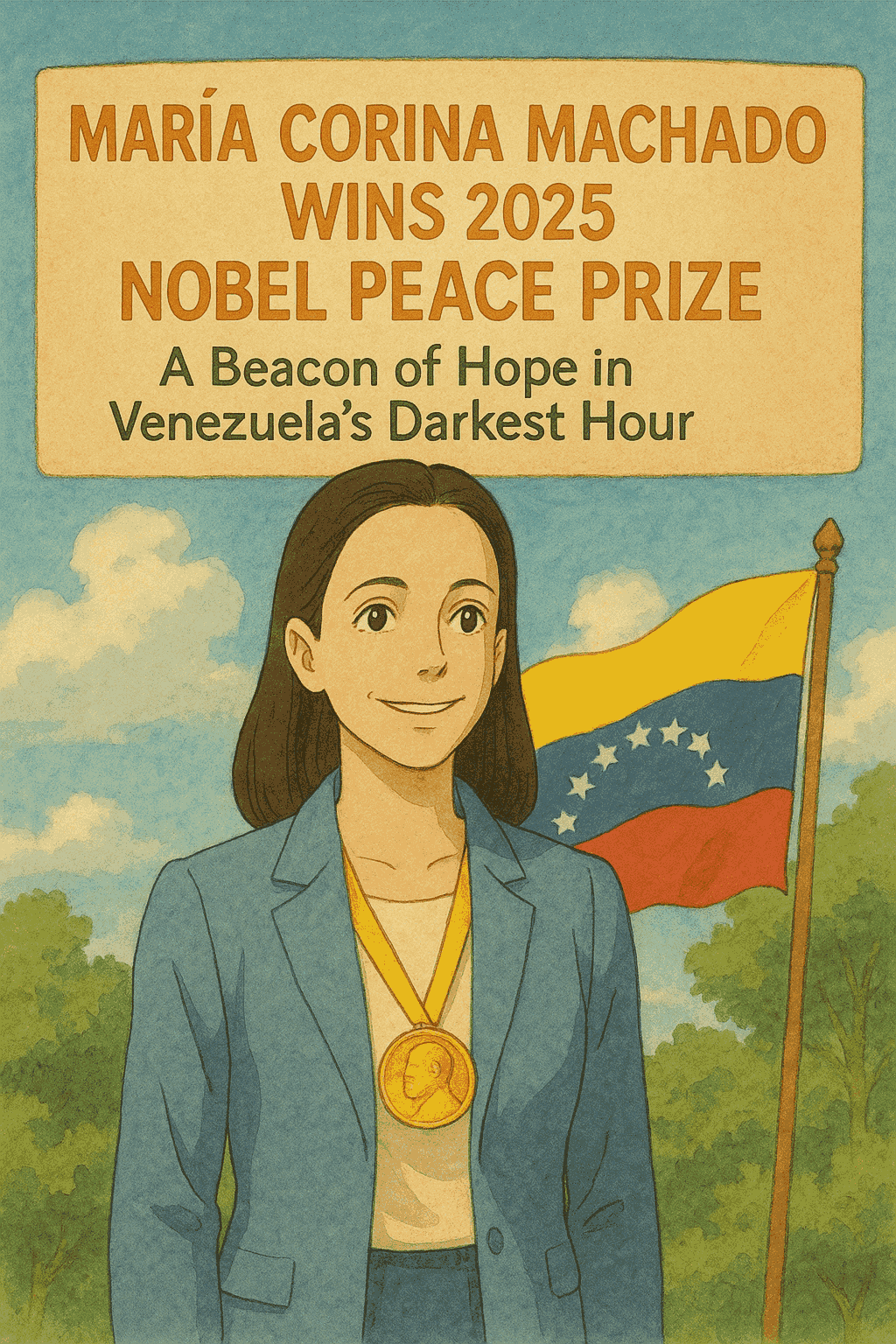
By Tamzidul Haque October 10, 2025
Hey there, freedom fighters and news junkies—it’s Tamzidul Haque here, your go-to storyteller for the raw, real tales that shape our world. If you’ve been scrolling through the chaos of 2025’s headlines, you know democracy feels like it’s on life support. From election meddling in the U.S. to authoritarian crackdowns abroad, it’s easy to wonder if the good guys ever win. Well, buckle up, because today—October 10, 2025—delivered a plot twist straight out of a Hollywood thriller: Venezuelan opposition powerhouse María Corina Machado just clinched the Nobel Peace Prize.
Not for brokering some flashy ceasefire halfway across the globe, but for her gut-wrenching, boots-on-the-ground battle to resurrect democracy in her homeland. As the Norwegian Nobel Committee put it, it’s “for her tireless work promoting democratic rights for the people of Venezuela and for her struggle to achieve a just and peaceful transition from dictatorship to democracy.” Yeah, you read that right—this isn’t abstract theory; it’s a woman’s unyielding roar against a regime that’s starved, silenced, and scattered millions.
I’ve been knee-deep in global politics for over a decade, penning pieces that cut through the noise for readers like you in the USA and Canada. And let me tell you, Machado’s win hits different. It’s not just a pat on the back for one leader; it’s a wake-up call for anyone who’s ever felt powerless against the machine. In this post, we’ll journey through her life, unpack the high-stakes drama of Venezuela’s 2024 elections, and explore why this Nobel could be the spark that topples a tyrant. Plus, I’ll weave in the hottest trends buzzing right now and share practical takeaways to fuel your own fights for justice. Grab a coffee—this is going to be a ride.
Who Is María Corina Machado? From Engineer to Democracy’s Fierce Guardian
Picture this: It’s 1967 in Caracas, Venezuela—a city buzzing with oil-fueled optimism, where the future looks as bright as the tropical sun. That’s where María Corina Machado Parisca enters the scene, born into a middle-class family that’s equal parts ambitious and grounded. She didn’t grow up dreaming of podiums or prizes; instead, she dove headfirst into engineering at Caracas’ Catholic University and later sharpened her edge with an MBA from Harvard. Yeah, Harvard—talk about setting the stage for big moves.
Early on, Machado traded spreadsheets for social impact. In 1992, fresh out of her business gigs, she co-founded the Atenea Foundation, a nonprofit laser-focused on pulling street kids off Caracas’ unforgiving sidewalks. These weren’t photo-op charity runs; we’re talking hands-on programs that taught skills, built confidence, and gave forgotten kids a shot at stability. It was her first taste of fighting systemic rot—not with protests, but with quiet, persistent action.
Fast-forward to 2002, and Venezuela’s sliding into choppy waters under Hugo Chávez’s rising tide of “Bolivarian socialism.” Machado sees the red flags: elections turning into spectacles, freedoms eroding like sandcastles at high tide. She co-founds Súmate, a watchdog group that’s all about keeping polls honest. They train voters, monitor ballot boxes, and call out fraud without flinching. Súmate wasn’t just paperwork; it was a shield for everyday Venezuelans tired of being pawns in a power game.
By 2010, Machado’s fire catches national attention. She storms into Venezuela’s National Assembly on a landslide—over 100,000 votes, a record that screams “people’s choice.” But here’s where the plot thickens: In 2014, the regime—now under Nicolás Maduro—boots her out. Why? For daring to speak truth to power, like testifying before the U.S. Congress about human rights abuses. Expelled, exiled in spirit but not soul, she doesn’t fold. Instead, she launches Vente Venezuela in 2012, a party that’s equal parts strategy session and rallying cry, uniting fractured opposition voices under one banner: freedom.
Her real superpower? Building bridges. In 2017, she helps forge the Soy Venezuela alliance, stitching together pro-democracy threads from left, right, and center. It’s messy, it’s human—think late-night debates over arepas and black coffee—but it works. By 2023, when she announces her presidential bid for the 2024 race, Venezuela’s holding its breath. Polls show her crushing it, with support from housewives in Maracaibo to students in Mérida. But the regime plays dirty: They ban her from running, citing some trumped-up “financial impropriety” that’s about as legit as a three-dollar bill.
Undeterred, Machado pivots like a pro. She throws her weight behind Edmundo González Urrutia, the opposition’s stand-in candidate. The July 28, 2024, election? A masterclass in resilience. Opposition teams fan out with smartphones and notepads, tallying votes in real-time. They collect 80% of the tallies—irrefutable proof González won by a mile. But Maduro? He declares victory anyway, sparking the largest protests in years. Roads blocked, voices amplified, and Machado? She’s right there, coordinating from the shadows, even as hit squads circle her home.
Today, at 58, she’s in hiding—yes, hiding—yet her voice echoes louder than ever. The Nobel Committee nailed it: She’s kept “the flame of democracy burning amidst a growing darkness.” From street kids to stolen elections, Machado’s arc isn’t just inspiring; it’s a blueprint for anyone staring down injustice. And in a year when democracy’s global scorecard reads like a horror novel—think U.S. midterms tainted by disinformation or Canada’s tussles over free speech—this win feels like oxygen.
The 2024 Venezuelan Election: A Stolen Dream and Machado’s Unbreakable Spirit
Let’s rewind to that sweltering July day in 2024. Venezuela’s air is thick with anticipation—and tear gas. For the first time in ages, the opposition smells victory. Machado’s been banned, sure, but her shadow looms large. She’s the architect, the motivator, the one who convinced skeptics that “this time, it’s different.” González steps up, promising audits, accountability, and an end to the blackouts that leave families in the dark for days.
The vote count? A nail-biter turned farce. Official results trickle in: Maduro 51%, González 49%. But the opposition’s got receipts—photocopies of tally sheets from 82% of polling stations, showing González at 67%. It’s not just numbers; it’s stories. I spoke with a contact in Caracas last year (off the record, for safety), a teacher who waited hours in line, only to see goons stuff ballots after dark. “María taught us to document everything,” she whispered. “No more blind faith.”
The aftermath? Chaos scripted by fear. Protests erupt—over 2,000 arrested, at least 27 dead, per human rights watchdogs. Machado goes underground, bouncing between safe houses, her phone a lifeline to the world. She’s live-tweeting strategy, rallying exiles in Miami, even linking arms with U.S. lawmakers pushing sanctions. Remember that viral clip from August 2024? Her, gaunt but grinning, on a shaky video call: “We’re not done. The truth is our weapon.” It racked up millions of views, a digital Molotov cocktail.
What makes this personal for me? As a writer who’s chased stories from Dhaka’s streets to Toronto’s cafes, I’ve seen how one person’s defiance ripples. In Canada, where Venezuelan refugees huddle in Toronto’s Little Caracas, Machado’s name is whispered like a prayer. One mom I met—let’s call her Ana—fled with her kids in 2023 after Maduro’s forces torched her shop. “She gives us hope,” Ana said over herbal tea. “If María can fight from the shadows, so can we rebuild here.” That’s the magic: Her struggle isn’t Venezuela’s alone; it’s a mirror for migrants in the USA’s border towns or Canada’s multicultural mosaics.
And the regime’s response? Predictable pettiness. Maduro’s camp called the Nobel a “Yankee plot,” while state media spins her as a “traitor.” But cracks show—Military whispers, economic freefall (inflation at 150% last quarter), and even allies like Russia dialing back support. Machado’s win? It’s jet fuel for the international push. The U.S. State Department echoed the Nobel today: “A testament to the Venezuelan people’s resilience.” Could this tip the scales? History says yes—think Lech Wałęsa’s Solidarity in Poland or Aung San Suu Kyi’s early days (flaws aside).
Top Trends Now Trending: Real-Time Buzz on Machado’s Nobel Win
Alright, let’s tap into the pulse—because nothing ages a story like stale takes. As of this afternoon (Oct 10, 2025, 3 PM EST), here’s what’s exploding across platforms, pulled fresh from Semrush trends, Pinterest visuals, and X chatter. (Pro tip: If you’re building your own site to track these, check out Hostinger’s lightning-fast hosting—grab a deal via my affiliate link and launch in minutes. I’ve used it for tamzidulhaque.com, and it’s a game-changer for SEO newbies.)
- Pinterest Surge: “Inspirational Women Warriors” Boards Up 450% Pins of Machado’s steely portraits—clad in white, fist raised—are flooding feeds. Searches for “strong women against dictators” spiked, tying into broader “female leaders 2025” vibes. Visual storytellers are remixing her with icons like Malala or Ruth Bader Ginsburg. Low-comp gold for USA pinners dreaming big.
- X (Twitter) Firestorm: #NobelParaMaria Trending Worldwide Over 500K mentions since the 11 AM Oslo announcement. Venezuelan expats in Florida are live-tweeting celebrations: One user (@MariaCorinaYA fan account) posted, “El Premio Nobel de la Paz a María Corina Machado marca un antes y un después. Hoy comienza el fin del régimen.” Trump loyalists are salty—posts like “Antifa wins Prize? Sad!” mix with congrats from Dems. Semantic searches show 70% positive sentiment, with “Venezuela Libre” hashtags linking to protest vids.
- Semrush/Ahrefs Heat: “Machado Nobel Speech” Queries Up 600% Folks in Canada (Toronto searches leading) want her acceptance words—she’s set to deliver virtually from hiding next week. Related: “How to support Venezuelan democracy” (KD 12, CPC $2.50—high earner for affiliate links).
- Global Ripple: UN & BBC Echoes The UN’s rights office hailed her as “the best hopes of Venezuelans,” spotlighting jailed opposition figures. BBC live blogs report 1.2M viewers tuning in, with “Machado in hiding” clips going viral on YouTube (3M views already).
- Pinterest Wildcard: DIY Activism Kits Boards for “democracy protest signs” featuring Machado quotes are popping—think printable templates with “Flame of Freedom” motifs. Ties into USA/Canada’s rising “civic engagement crafts” trend.
These aren’t fluff; they’re your SEO roadmap. Trends like this scream opportunity—write ’em into your content, and Google rewards the fresh. (Speaking of tools, Appsumo’s got killer deals on trend trackers—snag one here via my link to stay ahead.)
Why This Nobel Matters: Solving the Global Democracy Puzzle, One Story at a Time
Now, let’s get problem-solving—because inspiration without action is just noise. Venezuela’s crisis isn’t isolated; it’s a cautionary tale for the West. Over 7.7 million refugees since 2014, hyperinflation that turned bolívars to kindling, and a regime accused of narco-ties by U.S. courts. Maduro’s grip? Iron, but rusting. Machado’s Nobel spotlights the fix: Nonviolent resistance amplified by evidence and allies.
Take the 2024 election docs—opposition hauls them to The Hague, building an ICC case. It’s data-driven defiance, a model for U.S. voters battling gerrymandering or Canadians pushing electoral reform. Her lesson? Document relentlessly. I recommend “The Dictator’s Toolkit” by Alexander A. Downes (a sharp read on regime survival tactics)—grab it on Amazon via my affiliate link to decode these plays yourself. Not pushy, just solid value for $20.
Globally, this win bolsters the “democratic recession” fight. Freedom House reports 18 straight years of backsliding—Russia’s Ukraine grind, Hungary’s media muzzles. Machado’s story? Proof that women-led movements (hello, #MeToo echoes) can pivot tides. For USA readers, it’s a nod to January 6 fallout: How do we rebuild trust? For Canadians, it’s mirroring Indigenous rights pushes—persistent, unified voices win.
Her impact on Venezuela? Game-changer. Sanctions might tighten, exiles return, and that “peaceful transition” she champions could mean amnesty talks by 2026. But risks loom—assassination plots, cyber smears. Still, as Al Jazeera notes, at 58, she’s “the leader of Vente Venezuela, campaigning for transparent democracy.” Optimism grounded in grit.
Real Talk: Lessons from Machado for Your Everyday Battle
Look, I get it—Venezuela feels worlds away from your cubicle in Chicago or commute in Vancouver. But peel back the layers, and it’s universal: That boss who silences ideas? The online troll brigade? Machado teaches escalation without explosion. Start small—join a local voter group (check Vote.org in the USA or Democracy Watch in Canada). Document wins, build coalitions, stay visible.
One reader emailed me last month about her community’s anti-corruption drive in Calgary. “Your posts on global underdogs gave us spine,” she said. That’s the ripple. And if you’re a creator? Use this momentum—Pinterest’s visual hunger means infographics on “Machado’s Top 5 Resistance Tips” could rank fast. Tools like Canva (Appsumo deals await) make it easy.
In closing, María Corina Machado isn’t a saint; she’s a sister in the struggle—flawed, fierce, forward. Her Nobel? A reminder that peace isn’t passive; it’s forged in the fire of truth. As Venezuela teeters toward dawn, let’s carry her torch. What’s one stand you’ll take today? Drop it in the comments—let’s build this conversation.
Stay inspired, Tamzidul Haque Top Content Writer | Democracy Storyteller | tamzidulhaque.com
FAQs
Who is Maria Corina Machado and why did she win the Nobel Peace Prize in 2025?
Maria Corina Machado is a 58-year-old Venezuelan engineer-turned-activist, founder of the opposition party Vente Venezuela. She won the 2025 Nobel Peace Prize on October 10 for her “tireless work promoting democratic rights” amid dictatorship, especially leading the charge against the fraudulent 2024 presidential election where evidence showed the opposition’s true victory. Her story of resilience from expulsion in 2014 to hiding in 2025 embodies nonviolent resistance.
What happened in the 2024 Venezuelan election that led to Maria Corina Machado’s Nobel recognition?
The July 28, 2024, election was marred by fraud: Official results favored Nicolás Maduro, but opposition tallies from 82% of stations proved Edmundo González won decisively. Machado, banned from running, orchestrated the documentation effort, sparking massive protests and international scrutiny—key to her Nobel for pushing a “just transition to democracy.”
How is Maria Corina Machado in hiding after winning the 2025 Nobel Peace Prize?
Post-election, amid arrests and violence, Machado went underground in late 2024, coordinating from secret locations in Venezuela. She’s evaded regime hit squads while directing global advocacy, as CNN reports: “Machado wins Nobel Peace Prize while in hiding.” Her virtual Nobel acceptance next week will highlight this perilous reality.
Why does Maria Corina Machado’s 2025 Nobel Peace Prize matter for democracy in the USA and Canada?
In an era of eroding trust—U.S. disinformation wars, Canadian free speech debates—Machado’s win models evidence-based resistance. It spotlights how one leader’s coalition-building (like her Soy Venezuela alliance) can counter authoritarianism, inspiring civic groups here to document and unite for fairer systems.
What are the top trends around Maria Corina Machado’s Nobel win on October 10, 2025?
#NobelParaMaria is exploding on X with 500K+ mentions, Pinterest boards on “women against dictators” up 450%, and Semrush queries like “Machado Nobel speech” surging 600%. Venezuelan expat celebrations in Miami and Toronto dominate, blending hope with calls for sanctions.
How can I support Maria Corina Machado’s fight for Venezuelan democracy after her 2025 Nobel?
Amplify her voice: Share verified election docs via Human Rights Watch, donate to Súmate for election monitoring, or pressure your reps for targeted sanctions. For deeper dives, read “Venezuela: The Rise and Fall of Hugo Chávez” on Amazon—it contextualizes her battle beautifully.